A Quantum Leap into Lucknow’s Living History
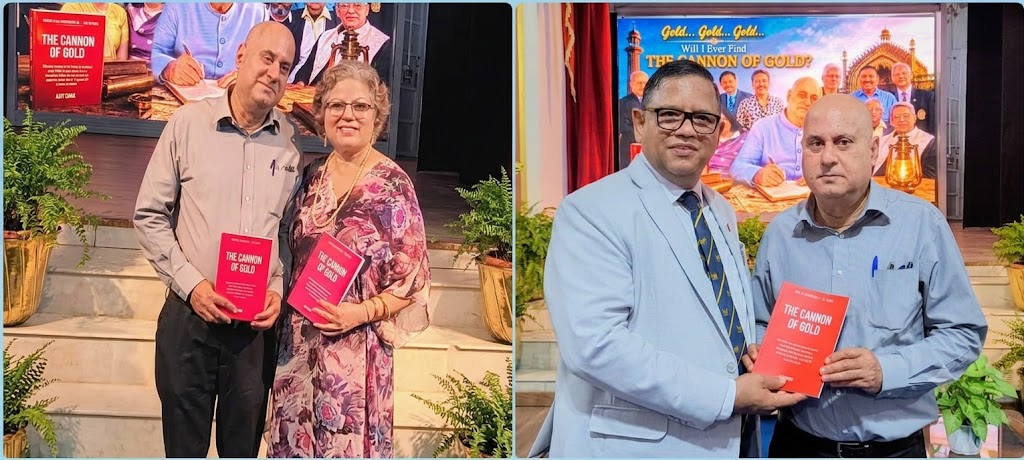
Title: The Cannon of Gold

Author: Ajit Chak
Series: Born in La Martiniere (Book 2)
Format: Paperback / E-book (~93 pages)
Publisher: Self-Published (2024/2025)
Availability: Pothi.com, Amazon (~₹500)
What happens when wartime imperative meets quantum theory in the heart of Awadh? In The Cannon of Gold, veteran journalist and author Ajit Chak delivers a compact, wildly imaginative historical sci-fi thriller that bridges World War II rhetoric, schoolyard legends, and alternate timelines. Spanning under 100 pages, this second entry in the Born in La Martiniere series is part speculative thriller, part heartfelt tribute to one of India’s most iconic educational institutions.

The Premise: Churchill in 1970s Lucknow
The narrative hinges on an audacious “what if”: Winston Churchill, facing the bleakest days of World War II, utilizes quantum time travel to leap forward to 1970s Lucknow. His goal? To seek counsel from a local newspaper editor on crafting the very speeches that would rouse the Allied forces against tyranny.
This unexpected temporal leap creates a ripple effect across eras. The path traces directly from Churchill’s WWII crisis to a local editorial desk in Awadh, where the exchange of ideas redefines his rhetoric. In turn, that momentum radiates outward into alternate timelines—weaving together the lingering echoes of the Indian Partition, lost treasures, renegade soldiers, re-imagined sports rivalries, and the quiet sacrifices of educators and students.
To ground his time-bending narrative, Chak invokes Hugh Everett’s Many-Worlds Interpretation of quantum mechanics. Rather than leaning on pure fantasy, the book gives its story a pseudo-scientific backbone, treating history not as a set track, but as a branching web of possibilities.
Themes and Literary Style
1. Nostalgia, Lore, and the “Khaki Uniform” Era
At its core, The Cannon of Gold is steeped in the traditions and ethos of La Martiniere College. Mottos like Nil Desperandum (Never Despair) and Labore et Constantia (By Labour and Constancy) aren’t merely decorative epigraphs; they drive the actions of the characters. Chak frequently addresses the reader directly (“Were you there? Have you ever felt it that you were in a war once…”), inviting an immersive reflection on collective memory, duty, and patriotism.
2. The Journalist’s Lens
Chak’s background as a senior political journalist—previously reflected in works like Kashmir Storm—informs the book’s dialogue and political undertones. The prose carries a crisp, conversational momentum. Rather than relying on continuous high-octane action, the narrative thrives on dialogue-heavy encounters, historical debates, and reflective pauses.
| Element | Literary Execution |
| Pacing | Brisk and episodic; ideal for a single-sitting read. |
| Tone | Reflective, patriotic, and speculatively bold. |
| Structure | Interwoven timelines tied together by institution lore and quantum mechanics. |
Strengths & Considerations
What Works Well
- Unapologetically Unique Concept: Merging Winston Churchill’s wartime rhetoric with 1970s Lucknow journalism creates an immediate hook for history and speculative fiction enthusiasts.
- Emotional Resonance: For Old Martinians, Lucknow residents, or readers fond of institutional heritage, the book offers a rich layer of local color and nostalgic pride.
- Accessible Length: At roughly 93 pages, it avoids fluff, delivering a quick, intriguing narrative path.
Things to Keep in Mind
- Niche Audience Appeal: Heavy integration of school-specific terminology, traditions, and local geography means readers unfamiliar with La Martiniere or Lucknow’s cultural milieu may miss some of the subtler nods.
- Indie Execution: As a self-published novella, the narrative structure can feel conversational or meandering in places rather than strictly plot-driven.
The Verdict
The Cannon of Gold is a passionate, eccentric gem that blends historical homage with quantum whimsy. It doesn’t aim to be a sprawling sci-fi epic; instead, it reads like a localized, speculative tribute to resilience across generations.
Recommended For:
- Alumni and friends of La Martiniere College (“Martinians”).
- Fans of light, localized historical fiction with high-concept sci-fi twists.
- Readers interested in Indo-British historical overlaps and creative “what-if” storytelling.


 ---------------------------------------------------------------------------------------------------